Paphos, Cyprus: One Heritage Name Covers More Than One Place
Paphos is a World Heritage property with distinct archaeological components, not a single room of mosaics. UNESCO identifies remains at Kato Paphos and Kouklia. Understanding that structure helps an island visitor choose a focused cultural question without confusing a site name with one entrance or one continuous walking area.
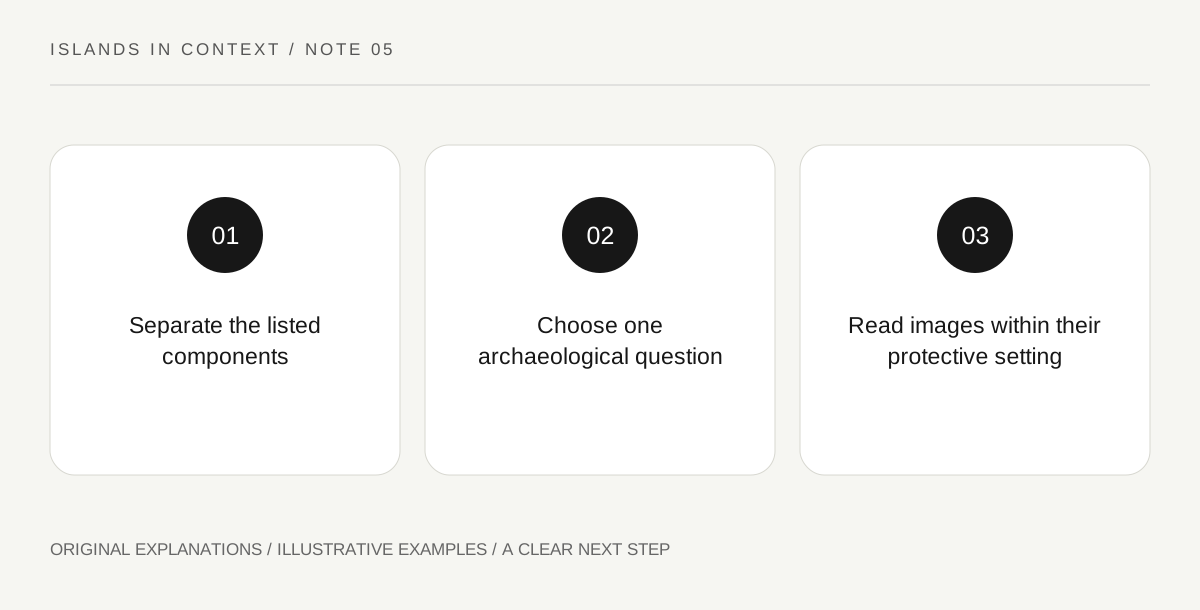
Original explanatory diagram. Read the full method and limitations below.
Unpack the serial property
UNESCO describes three components at two sites: ancient Nea Paphos and the necropolis in the Kato Paphos area, plus Palaepaphos and the Aphrodite sanctuary at Kouklia. The listing therefore groups related places rather than defining one compact visitor enclosure. Locate the component that interests you before checking admission and transport. A hotel near the modern waterfront does not establish that every part of the heritage property is next door. Keep the official component names in your notes so searches for opening information lead to the intended archaeological area instead of a general destination page.
Choose mosaics as a specific reading task
The villas of Nea Paphos contain mosaics that UNESCO connects with Greek mythology and scenes of everyday life. A useful visit asks how a floor image relates to the room around it. Begin with the official label’s identification of the scene, then look at borders, figures and the arrangement of the surviving panel. Do not supply a mythological name merely because a figure resembles an image seen elsewhere. Fragments, restoration and incomplete survival can complicate identification. A careful description can be precise about a border or repeated motif while leaving the narrative interpretation to the site’s explanation.
Distinguish sacred, domestic and funerary evidence
The wider property includes a sanctuary, houses and a necropolis, which address different aspects of ancient life. That variety is the reason to avoid reducing the whole listing to one spectacular floor. Decide whether your main question concerns a domestic setting, worship or burial architecture. Each requires its own context, and one component does not stand in for all the others. A single visit can be intentionally narrow. The point is to know which evidence you are studying, not to claim complete understanding of Paphos after looking at one building or following one short route.
Treat conservation as part of what you see
UNESCO discusses preservation of the archaeological fabric and the mosaic floors. Shelters, barriers and controlled viewing positions support that work and shape the modern visit. A photograph of an uncovered panel from another year does not prove the same viewing conditions today. Check the relevant authority’s current access information before travel and follow the site’s arrangements. In a notebook, distinguish the ancient image, the surviving condition and the modern protective setting. That three-part record makes the visit more informative than judging the panel only by how unobstructed it appears in a holiday photograph.
Illustrative component choice
A fictional visitor wants to understand mythological floor imagery and selects Nea Paphos as the main subject. The notebook still marks the necropolis and Kouklia as separate components, without pretending they have also been visited. At one permitted viewpoint, the visitor records a labelled scene, its border and the protective setting. The example is a method for a focused visit, not a route or admission guarantee.
Practical checks
Optional checkboxes save only in this browser.
Questions that come up
Does one map pin cover all UNESCO components?
No. The property includes distinct components at Kato Paphos and Kouklia. Match transport and visitor information to the particular place.
Must I visit every component in one day?
There is no need to force that. A focused visit can be useful when its scope is explicit and the unvisited components are acknowledged.
References and scope
These sources support the factual background. Examples and exercises are original illustrative teaching material. References do not imply endorsement.
- UNESCO: Paphos — Serial components at Kato Paphos/Kouklia, mosaics and archaeological conservation.