Santa Cruz, Galapagos: Read a Research Station Through Its Public Areas
The Charles Darwin Research Station in Puerto Ayora combines ongoing science with identified public spaces. The Charles Darwin Foundation describes exhibitions, gardens, interpretation and collections viewing. A visit can reveal how conservation knowledge is built without assuming that every laboratory, project area or neighbouring wildlife facility is included in one admission.
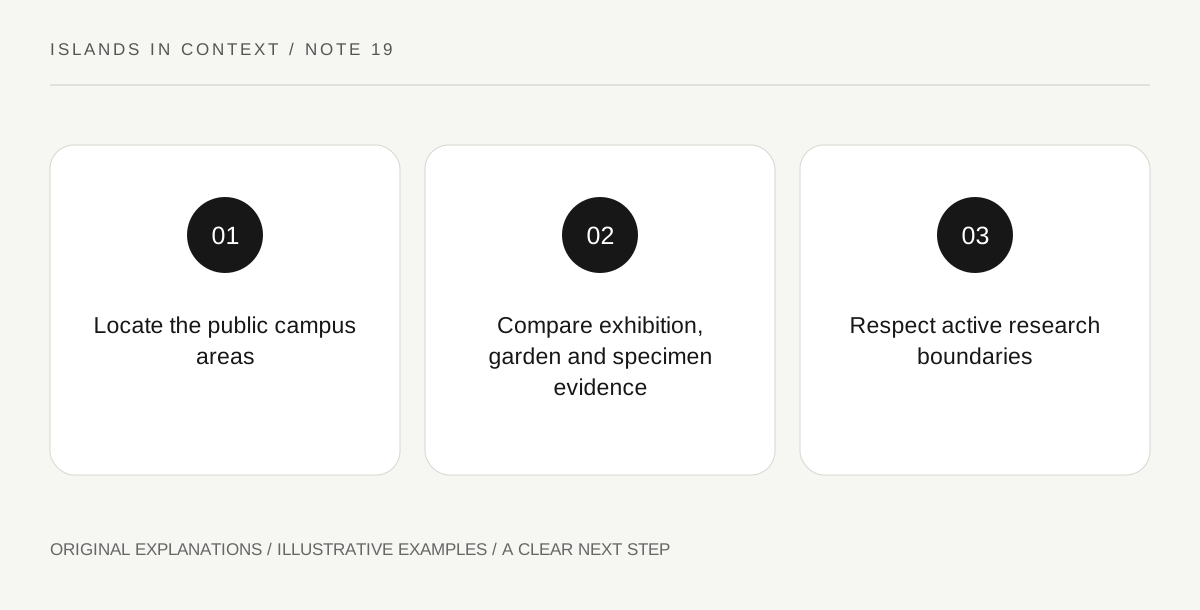
Original explanatory diagram. Read the full method and limitations below.
Identify the institution and campus
The foundation locates its research station on Santa Cruz in Puerto Ayora and describes its role as a base for research and conservation. Begin with the current campus map, not a general island excursion advertisement. The station is an institution with several functions, so the public visit should be understood as a selected view into that work. A visitor can learn about scientific questions and conservation without joining a research team. Keep the foundation’s own public-area description attached to the plan, especially if another provider advertises a combined activity using the broad name of the station.
Choose the exhibition as an explanation of work
The public campus description includes the Charles Darwin Exhibition Hall and interpretation facilities. These can introduce research history, natural-history material and changing displays. Select a question such as how evidence supports a conservation decision or how an island species is studied over time. Read the actual exhibit labels for the projects presented during the visit. Do not turn a broad institutional mission into a claim that every current research programme has a public demonstration. A temporary display may also change. The useful outcome is a clearer understanding of the method or question represented, not an invented encounter with a particular scientist.
Distinguish collections from wildlife viewing
The foundation describes natural-history collections and a public observation corridor. Scientific specimens preserve information for research, and the context differs from watching live animals in their habitat. Ask what a specimen’s label records: identity, place, date or other evidence relevant to the collection. A view through a corridor does not grant entry to storage or laboratory areas. Likewise, any separately managed tortoise or wildlife facility needs its own current access information. Keep institutional boundaries visible instead of assuming a familiar campus name proves one universal ticket, guide requirement or complete visitor route.
Let gardens and interpretation connect science with place
The station’s listed public areas include native gardens and a shade house, offering another kind of conservation interpretation. Observe through the permitted route and use labels rather than assuming every plant is endemic or that a specimen can be handled. Check the current campus guidance for opening and any separately organised activity. An independent town-based visit can complement a wider Galapagos trip because it addresses how knowledge is recorded and used. Its value does not depend on a wild animal appearing at the right moment. The distinction between a collection, a garden and a field observation is itself a useful scientific lesson.
Illustrative evidence comparison
A hypothetical visitor compares an exhibition panel, a labelled garden plant and a collections-viewing explanation. The notebook records what each kind of evidence can answer and what it cannot. A preserved specimen is not described as a live wildlife encounter, and an exhibition about a project is not called participation in that research. The exercise uses the campus’s public role without inventing laboratory access or a staff interview.
Practical checks
Optional checkboxes save only in this browser.
Questions that come up
Does a research-station visit mean joining field research?
No. The foundation identifies public visitor areas. Research participation and access to working facilities require separate explicit arrangements.
Are collections the same as wildlife viewing?
No. Collections preserve scientific evidence, while wildlife observation concerns living animals in a particular setting. Keep those experiences and their access arrangements distinct.
References and scope
These sources support the factual background. Examples and exercises are original illustrative teaching material. References do not imply endorsement.
- Charles Darwin Foundation: campus — Puerto Ayora research station and specifically identified public exhibition/garden/library areas.
- Charles Darwin Foundation: collections — Scientific specimens and public observation corridor; laboratory access not inferred.