Jeju’s Haenyeo: Living Knowledge Is More Than a Diving Performance
Jeju’s haenyeo culture concerns women who harvest from the sea, transmit knowledge and organise work within a community. UNESCO’s intangible-heritage record describes those relationships. Learn through interpretation and authorised cultural opportunities rather than treating working divers as an attraction that must appear at a fixed time for visitors.
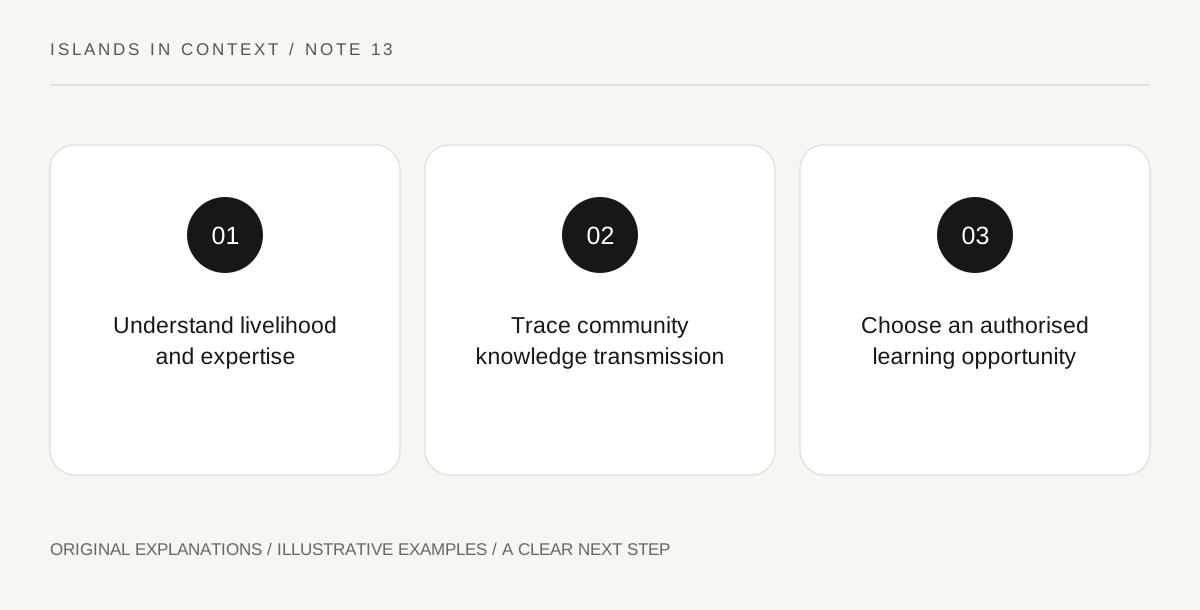
Original explanatory diagram. Read the full method and limitations below.
Begin with livelihood and knowledge
UNESCO identifies the haenyeo as a community of women divers who gather marine products for a living without supplied breathing equipment. Their knowledge concerns the sea and its living resources, not simply an impressive ability to hold a breath. A visitor’s useful starting question is what must be learned to participate in that working culture. Do not translate a descriptive account of experienced practitioners into instructions for trying the activity yourself. The heritage record explains cultural significance; it is not a recreational diving lesson, a medical assessment or permission to enter a fishing area.
Recognise experience and guidance
The UNESCO account distinguishes experience groups and describes senior divers guiding others. This helps explain why the culture is more than a set of individual athletic achievements. Knowledge, judgement and responsibility develop within relationships. When viewing museum material or an authorised presentation, look for how learning and seniority are explained. Avoid ranking real people through a visitor’s quick impression of age or apparent performance. An exhibition may use historical photographs, contemporary testimony and tools to present different parts of the practice. Keep the dates and sources of those materials visible rather than assuming every image depicts the present working community.
Connect transmission with institutions
UNESCO describes knowledge passing through families, schools, associations, the Haenyeo Museum and local fishery cooperatives. The cooperatives’ connection with fishing rights is particularly important: the coast is not an unlimited stage open to anyone who wants to imitate a photograph. A cultural visit can ask how community rules and learning support continued practice. If choosing a museum or organised encounter, check its current programme and the actual host. Do not assume heritage recognition creates a daily performance, a guaranteed sighting of working divers or a right to follow them into their working space.
Keep recognition separate from a frozen tradition
Intangible heritage is maintained by people who make decisions in changing conditions. UNESCO’s record connects the culture with women’s status, environmental knowledge and community management. These are living subjects, not merely costumes or equipment preserved from the past. Listen to the practitioners’ own accounts when available, and avoid speaking for the entire community after one presentation. For photographs, follow the host’s guidance and obtain appropriate consent. The strongest visitor outcome is a more precise understanding of work, transmission and collective responsibility, whether or not divers happen to be visible offshore during the visit.
Illustrative museum question sheet
A fictional visitor prepares three questions: who teaches new practitioners, how experience is recognised and how the community manages access to its fishing grounds. During a museum visit, answers are linked to particular labels or testimony. Any unanswered question remains open. The example neither reports an actual encounter nor promises a demonstration, and it gives no breath-holding or diving instructions.
Practical checks
Optional checkboxes save only in this browser.
Questions that come up
Does UNESCO recognition mean a daily public performance?
No. Recognition describes the cultural practice and its significance. Any organised visitor presentation has its own current programme and conditions.
Can I try the practice after reading about it?
This article provides cultural interpretation only. The expertise and access arrangements described for practitioners do not establish recreational permission or personal suitability.
References and scope
These sources support the factual background. Examples and exercises are original illustrative teaching material. References do not imply endorsement.
- UNESCO: Jeju haenyeo culture — Working women divers, experience groups, knowledge transmission, fishery cooperatives and intangible heritage. Full indexed primary text read; bare direct URL serves limited application shell.