Guernsey’s Little Chapel: Read the Surface as a History of Making
The Little Chapel at Les Vauxbelets combines a miniature religious building with an extraordinary decorated surface. Visit Guernsey traces its construction and later care. Looking closely at materials, scale and successive work reveals more than treating the chapel as a quick photograph of something unusually small.
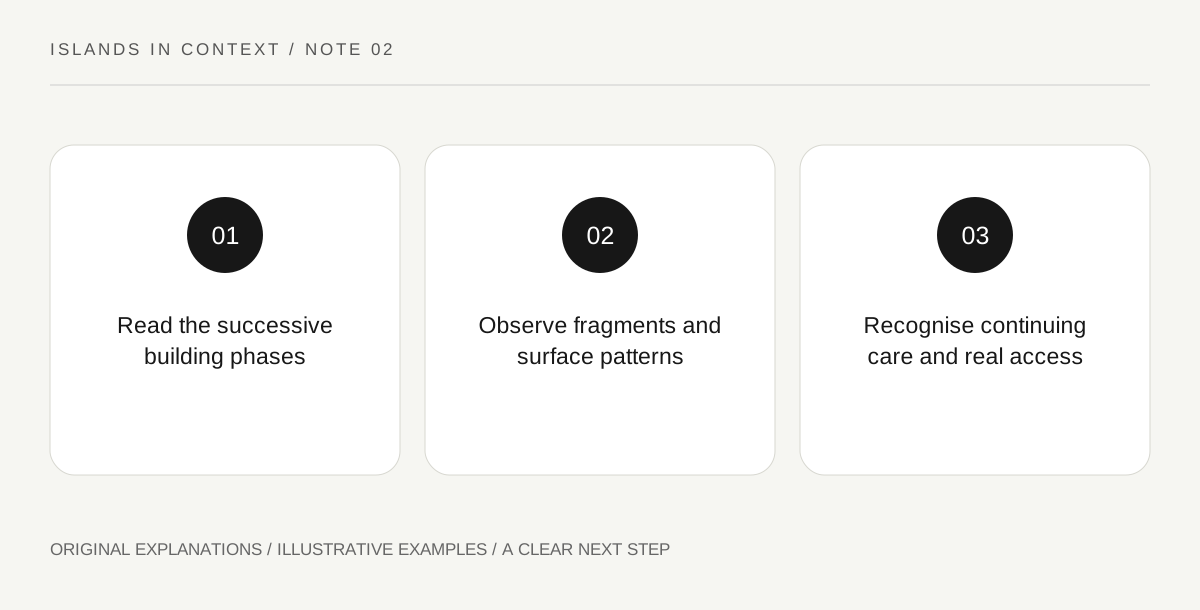
Original explanatory diagram. Read the full method and limitations below.
Start with the third version
Visit Guernsey identifies the present chapel as the third version of Brother Deodat’s project, which began in 1914. That history changes the reading of a tiny building: its form was developed through revision rather than appearing fully resolved in one attempt. The inspiration included the grotto and basilica at Lourdes. Use that relationship as a question about adaptation and scale, not a claim that the Guernsey building is a precise replica in every detail. Read the site’s interpretation for the actual stages. A miniature structure can contain a complicated history of design choices, practical constraints and personal commitment.
Look at fragments as building material
The official destination account describes collecting pebbles and broken china to decorate the shrine, followed by gifts and contributions. Individual fragments carry colour, texture and reflective qualities into a larger surface. Observe how small pieces cover edges, curves and openings without assuming every fragment’s origin is documented. A decorated ceramic piece may suggest a former object, but identifying its maker or date requires evidence. The useful visual question is how irregular pieces create an organised whole. Look from a respectful distance and avoid touching or testing attachments; close attention does not require putting pressure on a historic decorated surface.
Distinguish original making from continuing care
Visit Guernsey describes Brother Cephas continuing the decoration after Deodat’s departure and later restoration arrangements, with the Little Chapel Foundation caring for the site. The object therefore embodies more than one person’s work and more than one phase of maintenance. Ask which details the available interpretation can date and which remain uncertain. Repair is part of the chapel’s survival, not automatically a reason to dismiss it as inauthentic. At the same time, do not label a visibly fresh area as a particular restoration campaign without supporting information. A careful account acknowledges continuing stewardship without inventing a material history.
Match a close-looking visit to the real site
The official visitor information notes uneven steps and paths and warns about wet surfaces and the absence of external lighting. Those details matter even for a small attraction. Check the current opening information and access guidance rather than assuming a miniature building means an effortless route for every visitor. Give the chapel room to function as a religious and cared-for place, with other visitors moving through limited space. A simple notebook or a few permitted photographs can record the surface patterns without occupying a doorway for a long session. The aim is to understand making and care within the actual site.
Illustrative material notebook
A hypothetical visitor records three observations: an edge covered with small fragments, a contrast between pale and coloured areas and a doorway whose scale affects movement. The notes distinguish visible features from questions about provenance. “Possibly from a plate” remains a question unless interpretation confirms it. This example suggests a way to look; it does not claim a tested route or identify particular fragments in the chapel.
Practical checks
Optional checkboxes save only in this browser.
Questions that come up
Is the present chapel the first one built there?
No. Visit Guernsey identifies it as the third version of the project. Read the construction history to understand the successive rebuilding.
Does the small size make access simple?
Not necessarily. The site information identifies uneven paths and steps. Check the relevant access details for the individual visitor rather than judging from a photograph.
References and scope
These sources support the factual background. Examples and exercises are original illustrative teaching material. References do not imply endorsement.
- Visit Guernsey: Little Chapel — Brother Deodat, third chapel, broken china and pebbles, later care and uneven paths.