The Great Laxey Wheel: Follow Water, Motion and Mine Drainage
The Great Laxey Wheel on the Isle of Man was built to solve a mine-drainage problem. Manx National Heritage explains how hillside water drove a mechanism that removed water from below ground. Follow that chain of energy and motion to turn a landmark visit into an understandable engineering lesson.
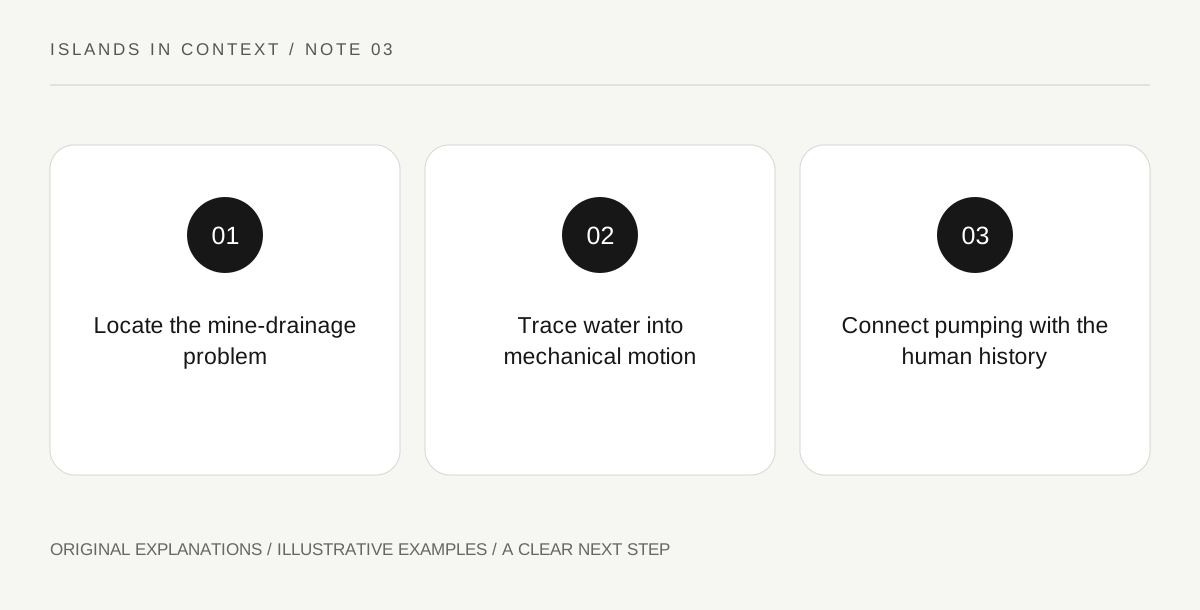
Original explanatory diagram. Read the full method and limitations below.
Begin with the problem underground
Manx National Heritage describes flooding as a persistent difficulty in the Laxey mines, where lead and zinc ores were extracted. The wheel was designed by Robert Casement and opened in 1854. Its purpose was not simply to turn dramatically above the valley. It provided power for pumps working elsewhere in the mine system. Start a visit by locating that problem in the interpretation: where did unwanted water collect, and where did it need to go? A structure becomes easier to understand when its function is clear before its size or appearance becomes the main subject.
Trace the incoming power water
The heritage organisation explains that water from the Laxey hillside was collected and carried through a system of channels and storage before reaching the wheel. Water delivered to buckets around the circumference helped turn it. Keep the driving water conceptually separate from the mine water being pumped out. They participate in one engineering system but have different roles. A sketch with two colours can make the distinction clear without requiring exact hydraulic calculations. Use the on-site interpretation for the actual route of the supply rather than wandering after a channel into areas that are not part of the public visit.
Follow the change in motion
The wheel’s rotational movement drove a long rod connected to a T-rocker, which changed horizontal movement into vertical movement for a pump rod. That sequence is the key engineering relationship. Draw arrows for rotation, back-and-forth rod movement and up-and-down pumping, making the conversion explicit. Do not assume that a casual photograph reveals the current operating state of every connected part. A heritage demonstration and a fully functioning nineteenth-century mine are different things. Read the signs and explanation for which components are visible, restored or represented, and leave unsupported technical details out of the account.
Read the public site and the working history together
The official access guide describes an open-air historic environment with the wheel, a mines trail and an old adit, with uneven ground and differing access possibilities. The guide is a description of the site, not a current guarantee that every area is open. Check the latest venue information for the intended date and ask about the specific route needed. Alongside the machinery, consider the people whose labour and risk made the mine work. Manx National Heritage’s educational material includes that human history. A good visit connects the elegant mechanism with the difficult underground problem and the community that lived with it.
Illustrative energy-flow sketch
A fictional learning sheet uses blue arrows for hillside water arriving at the wheel and green arrows for mine water leaving through the drainage system. Between them, black arrows show wheel rotation, the horizontal rod and the vertical pump action. The sketch is a simplified explanation, not an engineering drawing of every pipe or a claim that all historic components operate during a modern visit.
Practical checks
Optional checkboxes save only in this browser.
Questions that come up
Was the wheel itself carrying mine water to the surface?
The wheel supplied mechanical power to a pumping system. The useful explanation separates its driving water from the underground water being removed.
Does a wheel ticket establish access to every mine area?
No. Check the current venue information and route conditions. Historic paths and the adit can have distinct access arrangements.
References and scope
These sources support the factual background. Examples and exercises are original illustrative teaching material. References do not imply endorsement.
- Manx National Heritage: waterwheel learning — Mine drainage, hillside water, rods and T-rocker mechanism.
- Manx National Heritage: access guide — Historic open-air wheel/mine site; uneven routes and differentiated access.2024guide not current opening calendar.