George Town, Penang: Read a Shophouse Street as Living Port Heritage
George Town on Penang forms one part of a joint World Heritage property with Melaka. UNESCO emphasises its trading history, shophouses and living multicultural heritage. A focused street reading can reveal relationships between commerce, residence and community life without turning occupied buildings into an unrestricted open-air museum.
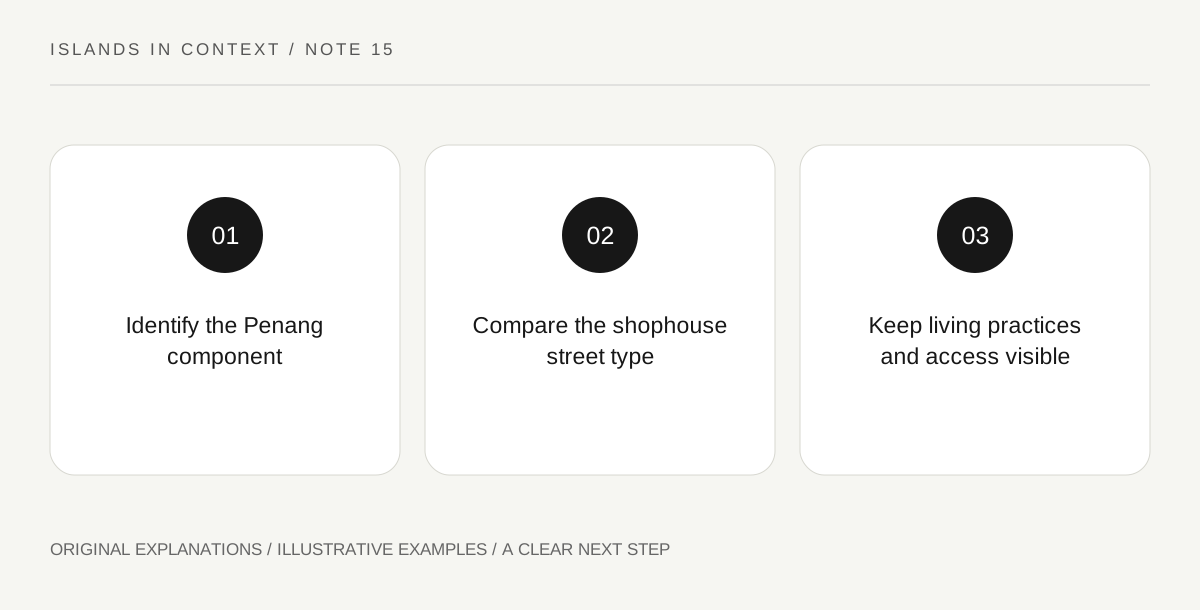
Original explanatory diagram. Read the full method and limitations below.
Separate the island city from the joint listing
The heritage title names both Melaka and George Town, but they are different places with complementary histories. George Town is the Penang component. Keep the city name attached to a building, image or historical account instead of assuming every feature in the joint description occurs on the island. UNESCO links George Town particularly with development from the late eighteenth-century British period, within a much wider network of Asian and European exchange. That framework helps identify the question for a visit: how did a trading port’s people and activities shape its buildings and streets over time?
Look at the shophouse as a building type
UNESCO identifies shophouses and townhouses as important elements of the urban fabric. A shophouse invites questions about the relationship between a street-facing commercial space and the rest of the building. Observe frontage, openings, depth where publicly legible and the continuity of adjoining structures. Do not infer a complete interior plan from one facade or assume every present use matches the original one. A measured-looking sketch can simply record what is visible from public space. The comparison becomes useful when several buildings reveal variation within a recognisable type rather than being collapsed into one decorative stereotype.
Keep intangible heritage beside the architecture
The listing also discusses languages, worship, festivals, food, music and daily life. These are not background noise around an architectural collection; they are part of the living heritage being recognised. A visitor can choose one current, authorised cultural opportunity and learn its context rather than expecting every practice to be performed on demand. Religious buildings may have different entry, dress and photography expectations. Follow the particular institution’s guidance and distinguish public celebration from private activity. A neighbourhood’s multicultural history should not become an excuse to assign individuals a fixed identity by their clothing, business or building decoration.
Make a short comparison with a clear boundary
Choose a permitted public stretch of street and compare a few examples through one question, such as how commercial fronts relate to adjoining buildings. Check current access separately for any interior museum or venue you wish to enter. Keep shop entrances, deliveries and ordinary movement clear while observing. The point is not to map every community in a single afternoon. A bounded visit can produce a thoughtful account of one building type and its living setting. Record which claims came from UNESCO, which from local interpretation and which are only your visible observations, so the result remains specific and honest.
Illustrative frontage study
A fictional visitor sketches three adjoining fronts from a public position, recording opening patterns and present visible uses without entering private space. An official heritage explanation supplies the building-type context. A separate note identifies a question about change that the facade alone cannot answer. The exercise is illustrative and does not identify a particular occupied address or claim that every shophouse follows one interior arrangement.
Practical checks
Optional checkboxes save only in this browser.
Questions that come up
Are George Town and Melaka one place to visit?
No. They are distinct city components of a joint heritage property. Match maps, venue information and transport to the city actually intended.
Can I enter any shophouse because it is historic?
No. Many buildings remain occupied homes or businesses. Historic significance does not create unrestricted public interior access.
References and scope
These sources support the factual background. Examples and exercises are original illustrative teaching material. References do not imply endorsement.
- UNESCO: George Town and Melaka — George Town island-port shophouses and living multicultural heritage; distinct city components.