Aapravasi Ghat, Mauritius: An Arrival Site with a Global Labour History
At Port Louis, Aapravasi Ghat preserves remains of an immigration depot associated with indentured labour. UNESCO connects this small waterfront site with a far-reaching nineteenth-century system and the memories of descendants. Read the surviving spaces as evidence of arrival, administration and movement rather than as an ordinary historic harbour building.
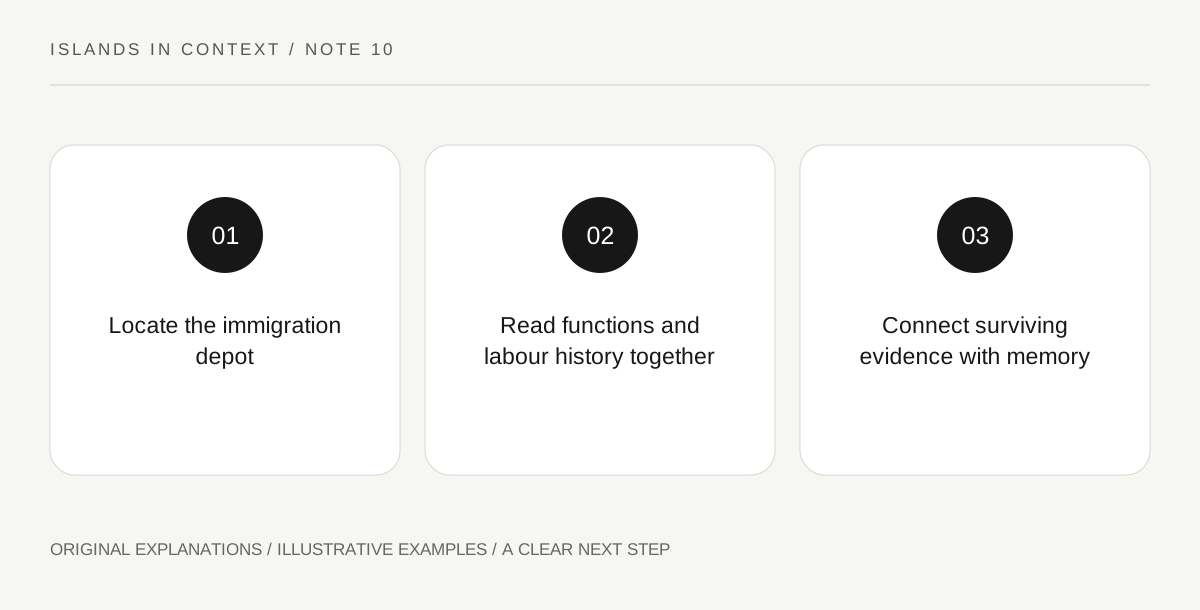
Original explanatory diagram. Read the full method and limitations below.
Distinguish the depot from a generic port
UNESCO locates Aapravasi Ghat beside Trou Fanfaron in Port Louis and explains its role in receiving indentured labourers. The site’s significance comes from that organised system of arrival and onward labour, not simply from being near ships. Start by identifying which surviving structures belonged to the depot. A modern waterfront scene can make the original sequence difficult to imagine, especially where later development has changed the setting. Use an official plan or interpretation to establish the historic boundary. The small scale of the surviving area should not be mistaken for the limited scale of the migration connected with it.
Read indenture with care
UNESCO describes the British colonial experiment in contracted labour after the abolition of slavery and the subsequent spread of the system. Indentured labour and slavery are different historical categories, but a label of contractual freedom does not remove the need to examine power, conditions and lived experience. Avoid presenting the transition as a simple story of uncomplicated progress. The depot connects economic policy with actual people who moved, worked and built families. A useful visit asks whose decisions are visible in administrative records and whose experiences need other forms of evidence, including memory, testimony and cultural traditions.
Connect surviving facilities to the arrival process
The heritage account identifies remnants associated with accommodation, kitchens, sanitation, a hospital block and a symbolic flight of steps. These functions make the depot legible as a sequence of bodily and administrative experiences. Compare a plan’s functions rather than inventing the route of a particular individual. A step or wall can support a question about movement through the depot, but it does not preserve every person’s feelings or circumstances. Look for interpretation that explains which elements survive and how archival material helps reconstruct the complex. Keep the distinction between original fabric and explanatory reconstruction visible.
Give descendants and memory a place in the visit
UNESCO emphasises the symbolic importance of Aapravasi Ghat for descendants and the traditions carried by the migrants. That means a visitor is entering a place of memory as well as an archaeological or architectural site. Read personal names and community accounts with the same attention given to building dates. Check the current visitor and interpretation-centre arrangements through the responsible institution before travelling. A focused question about how arrival is represented can connect structures, documents and memory in one visit. The result should acknowledge the broader diaspora without pretending that one site explains every indentured labour system or every family history.
Illustrative arrival-sequence exercise
A hypothetical visitor marks reception, daily needs and onward movement as three interpretive themes on a copied official plan. Surviving facilities and labelled documents are assigned to those themes only when the source supports the connection. A final note identifies whose perspective each record contains. The exercise does not reconstruct a fictional migrant’s exact experience or claim that every original depot building remains available to enter.
Practical checks
Optional checkboxes save only in this browser.
Questions that come up
Is this simply an old passenger terminal?
No. Its heritage significance concerns the organised indentured labour diaspora, the depot’s functions and the memories attached to that history.
Do the remaining buildings show the whole original complex?
UNESCO explains that only part of the former depot survives. Read plans and archival interpretation to understand the relationship between remnants and the larger historic site.
References and scope
These sources support the factual background. Examples and exercises are original illustrative teaching material. References do not imply endorsement.
- UNESCO: Aapravasi Ghat — Port Louis immigration depot, indentured labour diaspora, surviving facilities and symbolic steps.