Stone Town, Zanzibar: Read a Swahili Port Through Materials and Street Form
Stone Town on Unguja is a living Swahili coastal trading town. UNESCO describes a distinctive combination of building materials, courtyard houses, carved doors and narrow streets. A focused walk can connect those physical details with Indian Ocean exchange while respecting the homes, shops and religious places that continue to function there.
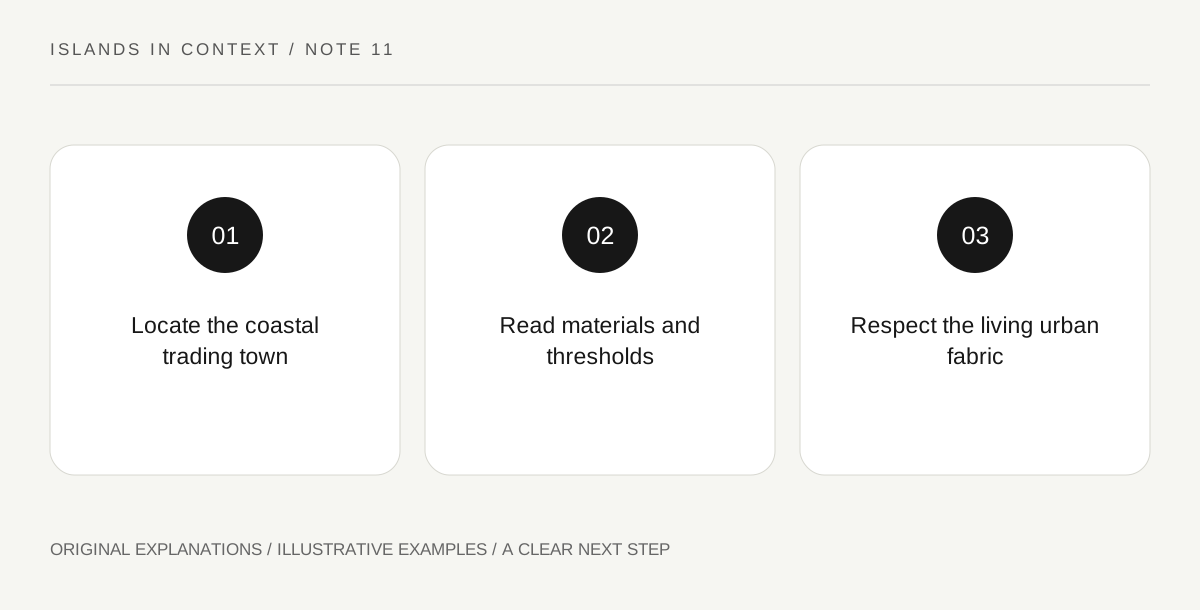
Original explanatory diagram. Read the full method and limitations below.
Begin with the Swahili coastal setting
UNESCO identifies Stone Town as an example of a Swahili trading town, shaped by African, Arab, Indian and European connections. Keep the indigenous coastal context visible rather than describing the town only as a collection of outside influences. Locate the waterfront, the narrow street network and the relation between commerce and residence. A short walk cannot establish the origin of every detail, so use reliable interpretation for historical attributions. The useful question is how a living port settlement expresses several connected histories without becoming a simple architectural catalogue in which every feature receives one national label.
Notice the construction beneath the finish
The heritage account describes coralline ragstone, mangrove timber and lime-based construction, often finished with plaster and limewash. The apparent surface is therefore only one layer of the building. A plastered wall should not be treated as evidence that there is no stone construction beneath it, and exposed material should not be touched or removed for inspection. Look at permitted examples and explanatory diagrams. Materials connect the town to coastal resources and building knowledge, but a visitor should not infer that harvesting those resources today is unrestricted. Historical material use and current environmental permissions are different questions.
Read doors, courtyards and shops as relationships
UNESCO’s description includes carved double doors, narrow approaches, courtyard arrangements and shopfront forms. These are useful clues to how public and private space meet. A doorway is an architectural subject, but it may also be the entrance to a home or workplace. Observe from public space and ask before photographing people or interiors where appropriate. Do not push through an open door because it appears in a heritage guide. Compare the threshold, the street width and the building’s visible function. The relationship can reveal more than a close-up of carving detached from the building and its current occupants.
Keep conservation and ordinary life together
Stone Town’s heritage account recognises continuing residential and commercial use as part of its character. Conservation is therefore about maintaining a living urban fabric, not freezing every street into an empty monument. Buildings can have repair needs, restricted areas or changed uses. Check current access for any named museum or historic building rather than assuming UNESCO status opens the whole town to entry. A useful visit can remain on permitted public streets and study a small set of features carefully. Leave with specific observations about materials and spatial organisation, while acknowledging that the town’s community has a much fuller relationship with those places.
Illustrative threshold comparison
A fictional visitor compares two publicly visible doorways: one connected to a shopfront and another to a more private-looking entrance. Notes cover the surrounding street, the visible construction and any official interpretation. No interior is entered without permission, and the visitor does not assign a religious or ethnic identity from decoration alone. The exercise studies spatial relationships rather than claiming to decode every door.
Practical checks
Optional checkboxes save only in this browser.
Questions that come up
Does a carved door identify one community with certainty?
Do not make that inference from appearance alone. Use reliable interpretation and avoid assigning present occupants an identity through an architectural motif.
Does World Heritage status mean every courtyard is public?
No. The historic town contains homes and businesses. Public streets and individual building access have different permissions.
References and scope
These sources support the factual background. Examples and exercises are original illustrative teaching material. References do not imply endorsement.
- UNESCO: Stone Town — Swahili port, coral ragstone/lime/mangrove materials, courtyards, carved doors and living urban fabric.