Rapa Nui: A Moai and an Ahu Are Different Parts of the Cultural Landscape
Rapa Nui’s monumental statues are inseparable from a broader landscape of platforms, quarries and community heritage. UNESCO distinguishes moai from ahu and describes conservation challenges. Learning those terms changes a visit from collecting statue images to understanding relationships between making, placement, history and the living people responsible for the place.
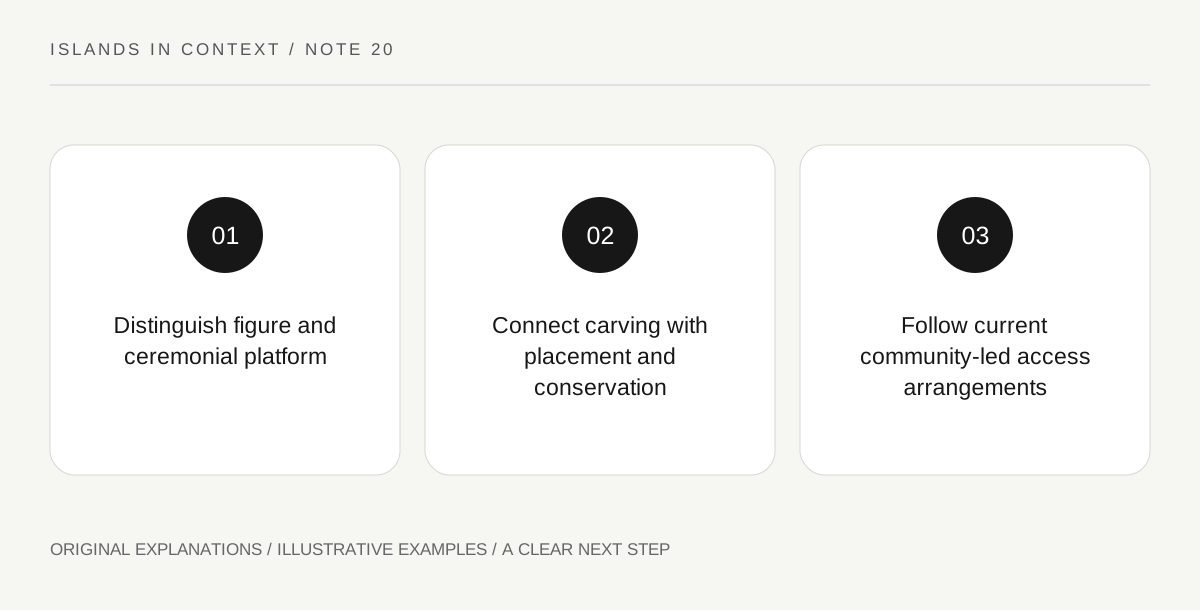
Original explanatory diagram. Read the full method and limitations below.
Separate statue and platform
UNESCO describes moai as monumental carved figures and ahu as ceremonial platforms. The two terms should not be exchanged as if both simply mean a statue. Begin with the relationship between figure, supporting structure and surrounding space. A platform can contain important archaeological evidence even when the most visible attraction is the figure above it. Do not climb or stand on archaeological fabric for a photograph. Use the current park’s permitted viewing arrangements. A simple labelled diagram can clarify the distinction while leaving detailed ritual interpretation to reliable sources and local knowledge.
Connect the quarry with the final setting
The UNESCO account identifies quarries, including Rano Raraku, as evidence of the carving process. A figure in a quarry and a figure associated with a completed platform occupy different positions in the production and placement history. That comparison raises concrete questions about material, work and movement. Avoid replacing unanswered historical questions with sensational explanations or claiming that every technique is fully settled. A visitor can distinguish stages without pretending to reconstruct the exact journey of an individual statue. The broader landscape includes domestic, agricultural and ceremonial evidence that complicates any story focused only on the largest figures.
Read conservation and restoration carefully
UNESCO discusses weathering, material stability and controlled restoration, including re-erection in some locations. A standing figure is therefore not automatic proof that it has remained upright and untouched throughout its history. Read the interpretation for the particular site. Equally, a restored setting should not be dismissed as meaningless: the evidence and decisions behind conservation deserve attention. Keep original fabric, historical change and modern intervention separate in your notes. Do not invent a date for a repair from its colour, and do not touch a surface to inspect its condition. Conservation information is part of understanding what survives.
Use current community and park information
Some heritage descriptions contain legacy management information. A more recent UNESCO account identifies the Ma’u Henua Indigenous Community’s management role, illustrating why current access should be checked through the responsible park arrangements rather than inferred from an old paragraph. Confirm the actual ticket, guide and site-entry requirements for the date and activity; this article does not freeze those rules. Listen to community interpretation as more than an optional addition to a monument tour. Rapa Nui is a living homeland with archaeological heritage, and a careful visitor keeps those two realities connected instead of treating the island as an abandoned stage.
Illustrative three-part study
A fictional visitor’s notebook has headings for carving, placement and conservation. Under each, the visitor records a source-supported observation and one unanswered question. The terms moai and ahu remain distinct, and any restoration information is tied to the particular location. This suggested method does not identify a prohibited route, promise entry to a quarry or claim firsthand knowledge of a community-led visit.
Practical checks
Optional checkboxes save only in this browser.
Questions that come up
Does ahu mean the carved statue?
No. In the heritage account, ahu refers to a ceremonial platform, while moai refers to the monumental figure. Their relationship matters to the site.
Can an older heritage page establish today’s access rules?
No. Historical descriptions can retain legacy management details. Confirm current arrangements with the responsible park and community sources for the actual visit.
References and scope
These sources support the factual background. Examples and exercises are original illustrative teaching material. References do not imply endorsement.
- UNESCO: Rapa Nui National Park — Moai statues vs ahu platforms, quarries, archaeological conservation; legacy management paragraph not used as current authority.
- UNESCO: Rapa Nui community management 2025 — Current community-management context through Ma’u Henua; supports avoiding outdated CONAF-only management assumption.