Cidade Velha, Santiago: Read Port Heritage Without Losing the Human History
Cidade Velha on Santiago in Cabo Verde preserves parts of the former Ribeira Grande. UNESCO links its streets, churches, fortress and pillory with Atlantic colonial expansion, enslavement and the development of Creole culture. A careful visit connects the surviving forms with that history instead of presenting the town only as an attractive old port.
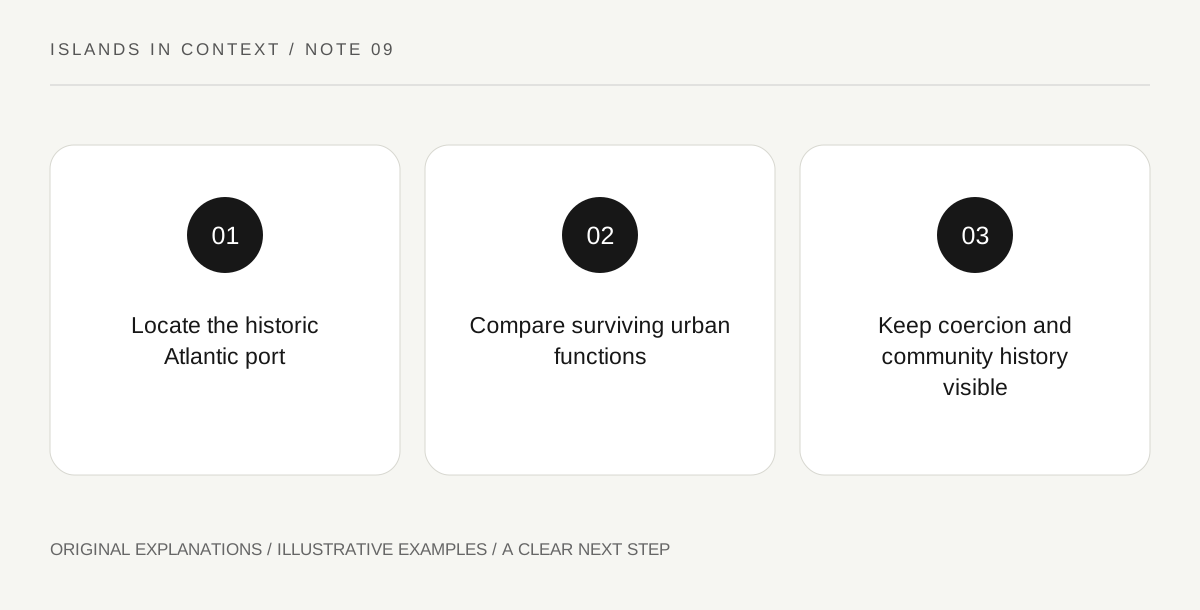
Original explanatory diagram. Read the full method and limitations below.
Locate the former Ribeira Grande
UNESCO identifies Cidade Velha in the south of Santiago and explains that the town was formerly called Ribeira Grande. Keep both names together when reading historical material. The port’s place in Atlantic networks is central to its significance, not an incidental detail beside the architecture. Begin with a map showing the coast, settlement and surviving monuments. A modern island visit covers only a small part of a much larger historical network. The map can help connect the local setting with movements across the Atlantic while avoiding a false impression that all those journeys were voluntary or equivalent.
Read monuments by their different functions
The listed remains include churches, a royal fortress and Pillory Square, alongside parts of the original street layout. These forms relate to religious, military, administrative and everyday urban life. Choose one comparison rather than assigning them all the same purpose. A fortress’s position can raise a question about control and defence, while a street pattern can reveal how a settlement was organised. Read the available interpretation for dates and uses. Do not make the pillory merely a decorative photo subject detached from the structures of authority and coercion that give the place its historical meaning.
Keep enslavement explicit
UNESCO describes the town’s association with the Atlantic trade in enslaved people and its role in colonial organisation. Use clear language about that history rather than allowing a broad phrase such as cultural exchange to conceal domination and forced movement. At the same time, recognise the development of Creole culture as a complex human history that cannot be reduced to a single monument. A label, testimony or community account can add a perspective that an architectural overview does not contain. Preserve the source and scope of each account rather than speaking as though all descendants share one identical narrative.
Visit a living town with a historical question
The heritage listing is a basis for learning, not a promise that every building is open to casual entry. Check current local visitor arrangements for monuments and any guided activity. Streets and houses also belong to the ordinary life of the community. A focused question about port control, urban form or the interpretation of enslavement can guide a short visit without demanding unrestricted access. If photographing, follow local and venue expectations and avoid staging images on protected fabric. The strongest result is a specific, sourced understanding of how the coastal town’s physical remains connect with the people and systems that shaped it.
Illustrative paired reading
A fictional notebook pairs a plan of the port settlement with notes from interpretation at one religious site and one defensive site. A separate heading records the explicit history of enslavement rather than hiding it under a neutral trade label. The visitor leaves uncertain dates blank until a source supplies them. This is a proposed learning exercise, not a report of a guided visit or a guarantee of monument access.
Practical checks
Optional checkboxes save only in this browser.
Questions that come up
Is Cidade Velha on the island of Santiago?
Yes. UNESCO locates the heritage town in southern Santiago. Use the island and town together when identifying your destination.
Is a port-history description enough to explain the place?
Only if it includes the human systems behind that port. The history of enslavement, colonial power and Creole culture is central to the heritage account.
References and scope
These sources support the factual background. Examples and exercises are original illustrative teaching material. References do not imply endorsement.
- UNESCO: Cidade Velha — Santiago port, colonial street layout, churches, fortress, pillory and Atlantic enslavement/Creole history.